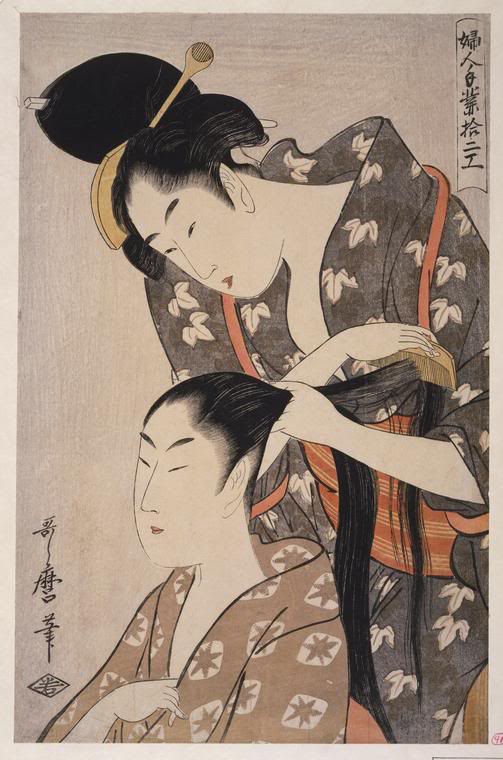
Recently I took my mom to see one of the most beautiful art exhibits I've ever seen. It's titled Japanesque: The Japanese Print in the Era of Impressionism, and its at the Palace of the Legion of Honor in San Francisco until Jan. 9, 2011.
The whole exhibit is really in three parts, along with an accompanying smaller exhibit of Japanese print books from the museum's collections. The first part of the main gallery looks at the Ukiyo-e themselves and examines the art form from its inception through the late 1800s. Included in this part of the exhibit is all of the series by Katsushika Hokusai, which is most famous for its "The Great Wave off Kanagawa":
 |
| from http://famouswonders.com/ |
For me, it is always exciting to finally view a painting or print that you've seen a million times in books or copied or spoofed a million times in popular culture (in fact, there are several homages to it in the exhibit by other Ukiyo-e artists). The original print did not disappoint; its colors are gorgeous and vibrant, and you are able to stand close enough to it to see all the details: the men in the boats coursing through the wave, Mt. Fuji in the background, the white spray coming off the waves. Several of the other people viewing the exhibit were amazed to see that it contained more than a wave!
Throughout the exhibit, the color and vibrancy of the Ukiyo-e were easy to see. There is a translucency to the way they layed the ink onto the rice paper; the rich color seems to shimmer. The exhibit notation also did a great job of explaining various transitions or techniques in the art form, such as how Ukiyo-e artists would allow the woodgrain to show if there were large areas of color, to have another pattern so it was not a flat, vast expanse of flat color.
 |
| The Japanese influence is easy to see in this print by Mary Cassatt from http://www.antiquesandfineart.com/articles |
The second part of the exhibit shows how the impressionists were highly influenced by the Japanese woodcuts, and how they incorporated it into their art. Again, the exhibit notations were excellent in explaining the influence found in each impressionist artwork, and often having a small picture of a specific woodcut they were referring to. The small pictures also had text telling you which gallery they were displayed in so you could go back and look at them for reference. The gallery was pretty much a who's who of Impressionists, such as Mary Cassatt, Edgar Degas, Edouard Manet, Henri de Toulouse-Lautrec, Vincent van Gogh, and James Abbott McNeill Whistler.
Also included in the second part of the exhibit was all of Henri Riviere's "36 Views of the Eiffel Tower." Directly influenced by Hokusai's Mt. Fuji series, Riviere's work was done while they were building the Eiffel Tower and contain many scenes where it is not complete or the workmen are in the process of building it. The entire series was done in tans and black and is gorgeous. To be able to directly compare the two series is very rare, and we are lucky the exhibit included both.
 |
| from http://www.art.com/ |
The final part of the exhibit were supplemental mini-exhibits adjacent to the main exhibit or nearby. To the right of the main exhibit entrance was a room that contained a seating area and flat-screen TV showing a movie about the exhibit; this area was also where the docents begin their lectures and tour. Across the room from the seating area plates showing how the prints were made. These show The Great Wave from beginning to end -- all fourteen plates -- so you can look at the original plate then how it prints up and the picture emerges.
In addition, there is a small room on the left before the cafeteria, which contains a selection of books.
Noted photographer Arthur Tress (b. 1940) began collecting Japanese books in the fall of 1965, and has continued to collect books and now has a comprehensive collection numbering several hundred volumes. He has selected a small group from his collection for this first of a two-part exhibition of illustrated books on the subject of Fuji, the iconic mountain that is the enduring symbol of Japan.The whole exhibit is well presented and spacious, and the day we went, not very crowded. It is well worth going to!